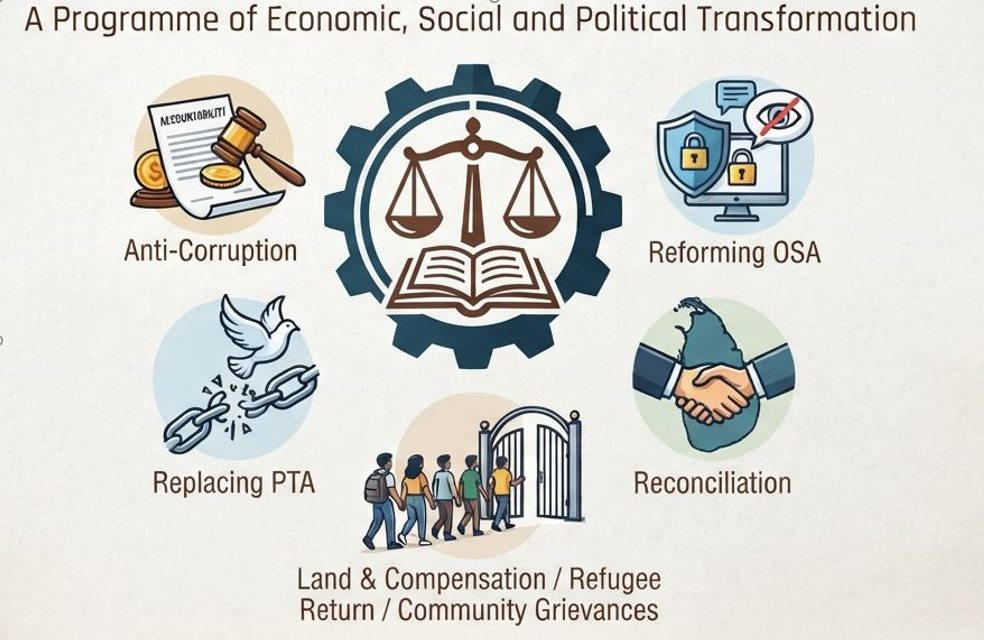
Under the current government, Sri Lanka is advancing a comprehensive reform agenda to strengthen governance, human rights, and social inclusion. To root out corruption, authorities are empowering the Bribery and Corruption Commission and rolling out the 2025–2029 National Anti-Corruption Action Plan to restore public sector transparency.
Among the most closely watched initiatives is the repeal of the Prevention of Terrorism Act (PTA). Developed alongside the United Nations and international partners, the replacement legislation aims to balance national security with fundamental freedoms-though human rights groups and minority communities will closely monitor its execution. Similarly, following stakeholder consultations, the government is amending the Online Safety Act to better protect freedom of expression while curbing harmful online activity.
Reconciliation efforts are accelerating through increased backing for the Office on Missing Persons, the Office for Reparations, and the Office for National Unity and Reconciliation. To complement these, authorities are evaluating a localized Truth and Reconciliation Commission. The justice system is also undergoing major structural changes. To clear backlogs and improve efficiency, the state plans to appoint more judges and extend their retirement age. Furthermore, a Supreme Court-led committee is reviewing a proposal for an independent prosecutor’s office to shield criminal prosecutions from political interference.
In conflict-affected regions, an Inter-Ministerial Committee now handles the sensitive process of land release, valuation, and compensation. To signal a commitment to the equal application of the law, authorities are actively pursuing several high-profile legal investigations. Additionally, new immigration frameworks will ease administrative barriers for undocumented Sri Lankan refugees returning from India, aiding their societal reintegration.
The broader agenda also targets the historical grievances of the Malayaga Tamil community, setting a crucial benchmark for the state’s commitment to minority rights. Concurrently, the government is tackling prison administration. A newly appointed Committee of Inquiry is investigating recent unrest at Negombo Prison, with findings expected to guide initiatives aimed at reducing overcrowding and strengthening rehabilitation programs.
This reform package represents one of Sri Lanka’s most significant recent attempts to overhaul its governance and justice systems. While analysts welcome these institutional upgrades, they caution that long-term success hinges on transparent execution and measurable results. The government insists domestic mechanisms can resolve the country’s accountability and human rights challenges, but both local and international observers will ultimately judge this approach by its tangible outcomes: genuine justice, protected minority rights, and truly independent institutions.