
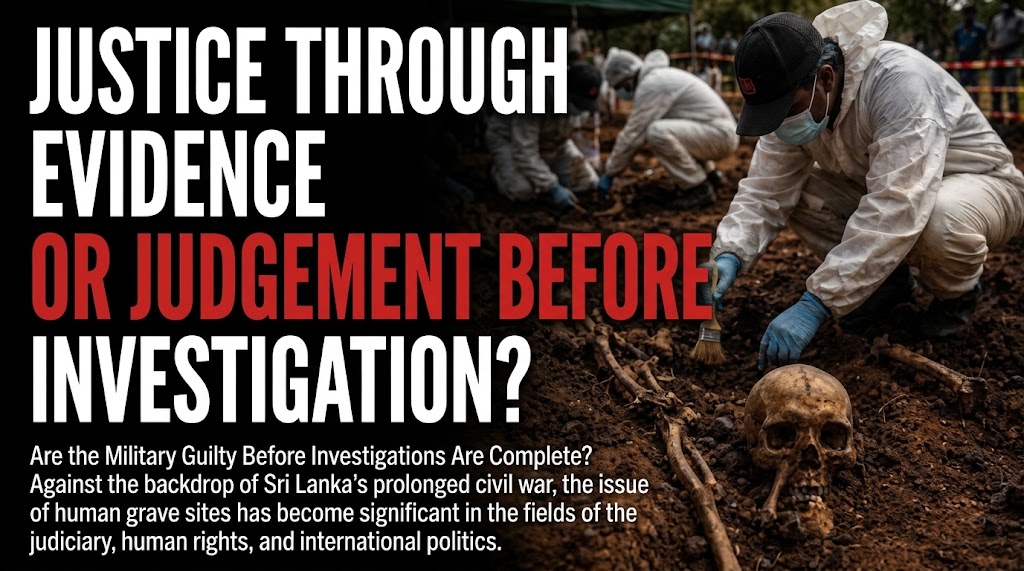
Human grave sites: Is blaming the military before the investigation concludes a preconceived ideology?
Human Grave Sites: Are the Military Guilty Before Investigations Are Complete? Against the backdrop of Sri Lanka’s prolonged civil war, the issue of human grave sites has become significant in the fields of the judiciary, human rights, and international politics. Investigations into human grave sites discovered in the Northern and Eastern provinces are essential for uncovering the truth behind these findings and ensuring justice for the affected people. However, linking these investigations to genocide and making allegations against the Sri Lankan military before the investigations are completed raises several questions and ambiguities. In this context, it is necessary to examine the facts surrounding human grave sites using scientific evidence, forensic examinations, and judicial investigations, while also considering how the international political environment is handling this issue.
What Is Genocide?
Genocide refers to acts committed with the intent to destroy, in whole or in part, a national, ethnic, racial, or religious group. Prominent examples in world history include the Holocaust, during which Nazi Germany systematically exterminated Jews during the Second World War; the 1994 genocide against the Tutsi in Rwanda; and the mass killing of Bosnian Muslim men and boys in Srebrenica in 1995. In the case of Sri Lanka, investigations into alleged wartime crimes and debates concerning accountability continue. In this context, it is not reasonable to classify incidents as genocide prematurely without assessing the relevant evidence and the findings of appropriate legal investigations.
During Sri Lanka’s three-decade-long civil war, several areas in the Northern and Eastern provinces, including Elephant Pass, Thoppigala, Muhamalai, Poonagari, Mannar, Omanthai, Mullaitivu, Puthukkudiyiruppu, Anandapuram, Chaalai, Mullivaikkal, Valikamam, Paranthan and Dharmapuram, were severely affected. High-intensity battles escalated. Civilians, Sri Lankan military personnel, and members of the Liberation Tigers of Tamil Eelam (LTTE) lost their lives during the war. Many people went missing, and circumstances may also have arisen in which some bodies could not be buried properly. In some cases, piecemeal body parts may have been recovered. When human skeletal remains and other evidence are discovered over time, it is essential to subject them to proper investigations rather than immediately classifying them as evidence of a mass grave or genocide.
For example, following the discovery of human skeletal remains during the excavation of the Kokuthoduvai mass grave, some irresponsible media outlets, politicians, and members of the Tamil diaspora portrayed the Sri Lankan military as guilty in the international arena. Subsequently, reports emerged that identification tags, uniforms, and cyanide capsules allegedly associated with the Liberation Tigers of Tamil Eelam (LTTE) had been discovered during further excavations. These findings were presented as evidence suggesting that the remains belonged to deceased LTTE members who may have been buried during the war. However, the media appeared to overlook or fail to adequately report these developments. Although such evidence is important to the investigation, it is not sufficient on its own to reach a definitive conclusion about the cause of death of those buried at the site or who was responsible. Therefore, labelling the mass graves on the international stage as sites created by the Sri Lankan military without sufficient evidence is an unacceptable approach.
Chemmani Investigations and Government Actions
The Sri Lankan government’s excavation work and judicial proceedings concerning the Chemmani human grave sites are significant. It is progressing and continues with expert panels. These activities are reported to have taken place in approximately three phases, extending over a period of up to 110 days. According to Jaffna Monitor, the third phase of excavation alone cost Rs. 21 million. Notably, the government has allocated time and financial resources to carry out investigations of this nature.
In 1996, 18-year-old Tamil schoolgirl Krishanthi Kumaraswamy was abducted, gang-raped and murdered in Kaithady, Jaffna. In 1998, six members of the Sri Lankan security forces involved in these crimes were sentenced to death. In 2004, the Supreme Court upheld the death sentences imposed on five soldiers. This incident is an important example of the principle that anyone who commits a crime should be brought before the law and given an appropriate punishment, regardless of who they are. Chemmani has also historically served as a burial ground. Therefore, carbon dating and DNA testing must be conducted. Otherwise, this could create misconceptions among younger generations who may wish to join the security forces in the future.
If a government had deliberately acted with the intention of destroying an ethnic group, questions may arise regarding why that same government would subsequently allocate funding and resources for such investigations. However, the government’s allocation of funds for investigations alone does not constitute conclusive evidence that the allegations are false. Similarly, it cannot be concluded that the government or military personnel are guilty merely because investigations are taking place.
Furthermore, it is reported that the Sri Lankan government provided rehabilitation to approximately 12,000 former LTTE members after the war. The people living in the Northern and Eastern provinces are also citizens of Sri Lanka, and protecting their rights and welfare is the government’s responsibility. The government has also taken steps to fulfil this responsibility by providing essential goods and services and working to improve living standards.
Are Accusations Being Made Before the Evidence Is Established?
It is claimed that approximately 22 human grave sites have been identified in Sri Lanka. In such cases, scientific investigations are necessary to establish the identities of the human remains discovered, the causes of death, the periods during which the remains were buried, and the individuals responsible for the incidents. Carbon dating and other necessary forensic examinations must be conducted appropriately.
It is not reasonable to portray the Sri Lankan military as guilty before such investigations and evidence assessments are completed. At the same time, it is also inappropriate to completely dismiss allegations concerning human grave sites before the evidence has been examined. Independent investigations, scientific evidence, and transparent judicial proceedings are essential to uncovering the truth.
Therefore, issues relating to human grave sites should be addressed not merely through the lens of international politics or ethnic-based opinions, but based on verified evidence and legal procedures. Avoiding premature conclusions about those responsible and reaching appropriate decisions only after the facts have been established would be consistent with justice and fairness.
The Chemmani mass grave investigation highlights the need for further scientific and judicial inquiries to establish the identities of the deceased, the causes of death, and the timing and circumstances of the burials. According to a report published by Uthayan on 20 October 2026, the interim report by Delgahawaththage Raj Kumar Somadeva, Senior Professor of Archaeology, notes that some archaeological features may resemble organized burial practices, while epidemics, natural disasters, and emergency burials have been suggested as possible explanations. However, none of these explanations has been conclusively established.
Although the Sri Lankan military was involved in a prolonged armed conflict against the LTTE, this does not remove the obligation to investigate credible allegations of violations of international humanitarian law. Equally, allegations must not be treated as proof of guilt without reliable evidence and due process. Premature international conclusions may affect military personnel’s reputations and legal standing. Therefore, accountability must be based on verified evidence, transparent investigations, and fair judicial procedures, ensuring justice for victims and their families while protecting the rights and dignity of military personnel.
Ultimately, the Sri Lankan government has been undertaking various initiatives to promote reconciliation, including measures through the Office on Missing Persons (OMP) concerning missing persons, development projects in the Northern and Eastern provinces, judicial investigations into human grave sites, forensic examinations, and rehabilitation and resettlement programmes. In this context, it is essential to uncover the truth surrounding human grave sites through scientific evidence and judicial investigations. Avoiding premature conclusions about those responsible before investigations are completed, reaching decisions based on evidence, ensuring justice for affected people, and building trust among ethnic communities are all important for achieving lasting reconciliation in the country.


