by Suhanya M Devanjee
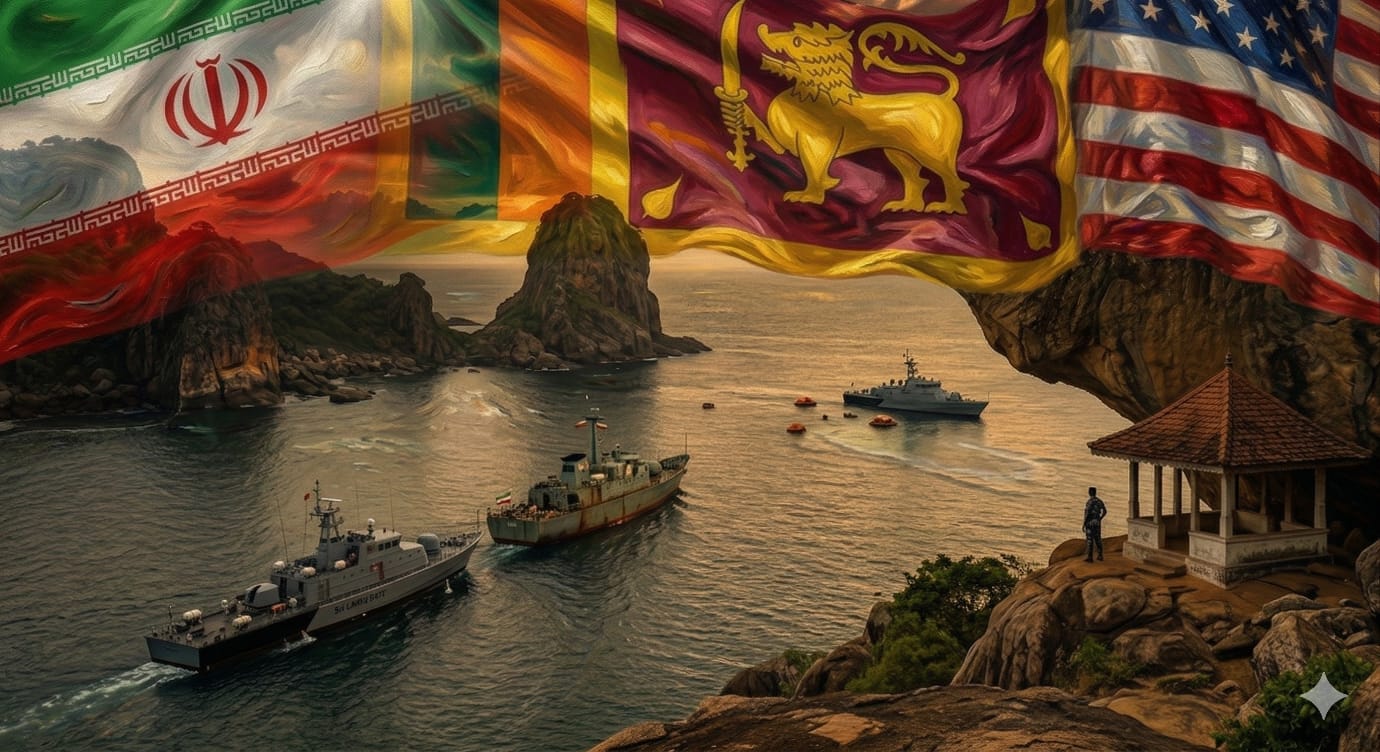
A distress signal reached Sri Lanka’s Maritime Rescue Coordination Centre in Colombo at 5 in the morning on March 4, 2026, Iranian warship, IRIS Dena, returning home after a multinational naval exercise off the coast of India, had been struck by U.S. torpedoes in international waters. It was sinking by the time Sri Lanka’s navy arrived, and only life rafts and an oil slick remained. Eighty-seven bodies were recovered and Thirty-two sailors were pulled from the Indian Ocean.
Within hours, a second Iranian vessel, IRIS Bushehr, appeared (engine failure!), 204 crew aboard, requesting assistance just outside Sri Lankan territorial waters. The government took custody of the ship to move it to Trincomalee for safekeeping. Sri Lanka had, in the space of 24 hours, become the custodian of both the living and the dead from a war it had nothing to do with.
What happened next was not just maritime law in action. It was a foreign policy statement, perhaps the most consequential one this country has made in decades. And it revealed something this government could build: a new national brand-NEUTRALITY.
The decision that started everything…
Eight days before IRIS Dena was struck, Sri Lanka had two requests on its table simultaneously. Iran sought port access for its naval vessels from 9 to 13 March, as part of a cooperation tour while the United States, meanwhile, requested permission for two combat aircraft (armed with eight anti-ship missiles) to land at Mattala Rajapaksa International Airport between 4 and 8 March.
“Had we said yes to Iran, we would have had to say yes to the US as well. Both were turned down to maintain Sri Lanka’s neutrality.” Said President Anura Kumara Dissanayake, Addressing Parliament
This was not fence-sitting. Sri Lanka was saying, clearly and publicly: we are not a platform for anyone’s war.
Does the difference matter: Non-alignment Vs Neutrality
Sri Lanka’s foreign policy tradition was born in non-alignment. When SWRD Bandaranaike came to power in 1956, he championed a doctrine of “friends of all, enemies of none” by removing British military bases, recognizing Cuba, supporting liberation movements in Africa, and condemning the Anglo-French-Israeli invasion of Egypt during the Suez Crisis. Non-alignment was vocal. It just refused to take military sides.
Neutrality is different. Neutrality says: we will not judge who is right. We will not name the aggressor. We will fulfill our legal obligations, care for the wounded, and return the dead, but we will not render a verdict on the conflict itself.
Some might argue the distinction is cosmetic, that non-alignment and neutrality are merely different uniforms for the same posture (the waiter and the stewardess). But the point worth pondering is this: non-alignment still acted. It named Suez. It named Diego Garcia. Neutrality, by design, does may not. When Sri Lanka’s Foreign Ministry responded to the U.S.-Israeli strikes on Iran, it did not name Washington or Tel Aviv. It called upon “all parties to de-escalate.” That is the language of neutrality, and the gap between those two words is wider than it looks. The shift is not a failure of principle. It is a more practical approach in Sri Lanka’s actual position in the world in 2026.
Sri Lanka is not neutral by accident; it is neutral because it cannot afford not to be. The United States takes 23 percent of its merchandise exports, over $3 billion, with 40 percent of garments going to American retailers. A million Sri Lankans work across the Gulf. When the Strait of Hormuz closed, petrol prices rose 8 percent within days, fuel queues returned, and the Colombo Stock Exchange triggered its circuit breaker. Sri Lanka had not forgotten 2022, when a government fell because it ran out of fuel.
The entanglements run deeper. Sri Lanka settled $251 million in oil dues to Iran through tea exports in 2024, carefully structured to avoid U.S. sanctions. That same year, Sri Lankan workers signed up for employment in Israel under a bilateral MOU. This is not hypocrisy. It is the mathematics of a small, recovering economy doing business with every side simultaneously. Neutrality here is not a luxury. It is a lifeline.
Why this is an opportunity?
The brand moment: Sri Lanka is not just surviving a crisis. It is, perhaps for the first time since 1976, building something that could define its global identity for a generation: a demonstrated record of neutrality in an era when almost every nation has been forced to choose.
Sri Lanka denied military access to a superpower. It denied it equally to the opposing side. It rescued the sailors of a sinking warship, regardless of flag. It took custody of a foreign navy’s vessel and protected it from further attack. In a world where “neutrality” is usually just a word, evidence is everything.
The question is whether Sri Lanka can be neutral. It has already proved it can. The question is whether it can turn that proof into power.