
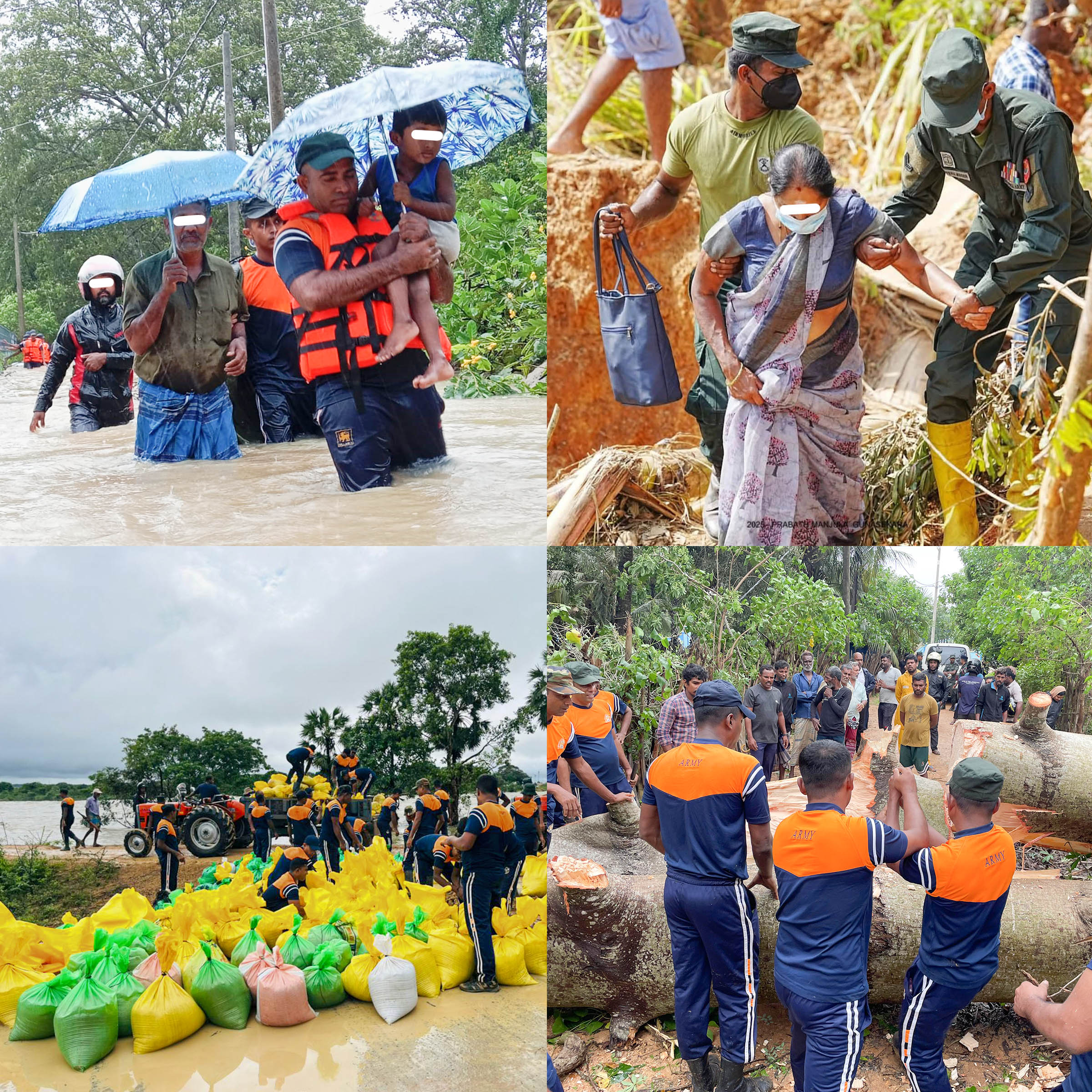
November 2025 Sri Lanka witnessed one of the worst natural disasters that was caused by the cyclone Ditwah in decades, resulting in more than 600 deaths, hundreds missing, and nearly a million people displaced or affected reflecting 10% of the population.
However, when floods swept across the country, the rising water did not pause to ask who lived in each home. It did not check ethnicity. It did not measure belief. It did not separate communities by language, caste, or the stories of their past. It simply broke through barriers. And in response, so did the Sri Lankan soldier.
Amidst this at every flooded road and every cut-off village, the uniform stood as a reminder of one truth: in moments of disaster, every life carries the same weight.
Our country has been shaped by lines: cultural lines, political lines, and sometimes even invisible social lines inherited through history. But during a crisis, these lines wash away. The first responders do not carry lists of who deserves rescue. They carry ropes, boats, stretchers, medical kits, and the determination to reach every person calling out through the rain.
And that is where the story changes.
That is where the story must change.
When a soldier lifts someone from a rooftop today, the world remembers him rescuing a mother whose son once fought against the State; carrying a man who once distrusted him; saving a child who will one day grow up with different opinions. At that moment, the only identity is humanity.
This is the part of our nation’s narrative that people soon forget: in disaster, humanity becomes the only identity that matters.
This, more than any statement or report, is reconciliation in motion.
Sri Lanka’s security forces have repeatedly shown that when the country cries out, the response is universal. Whether the call is from the North, South, East, or West, whether the voice cries in Sinhala, Tamil, English, or any other tongue—the answer is the same. The boots move. The hands reach out. The rescue begins.
His action is a lesson in empathy, equality, and national solidarity. The floods don’t differentiate. In a country still healing from past strife, when old divisions run deep—ethnicity, religion, region, politics—these moments display what unity is.
The sacrifices made by the soldier, sailor and airman remind us that his service carries a cost. It is not duty. It is bravery in rain, air, sea and land, risking one’s life so that another lives.
The country’s strength is not in divisions but its ability to rise together. If reconciliation is a national goal, these moments are its blueprint. A soldier is a father/ friend even to an enemy at a time of distress and a lesson for the policymakers.
This is the most powerful bridge a country can build.


